
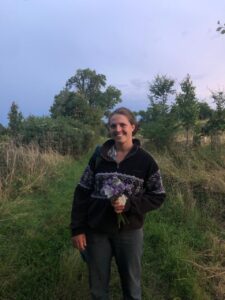
 Work attracting new Stockfree organic growers to start up farms is beginning to bear fruit. New entrepreneur Alice Rixon is now growing on seven acres in Chettle, North Dorset. She has spent the last year setting up the farm and will be selling her vegetables from June this year. She is a great example of having volunteered on a stock-free organic farm before starting her own venture.
Chettle is a “beautifully quirky” village of around 100 people who live and work as a community around shared spaces and celebrations. Her vegetables will supply the village shop which is well stocked with plenty of local, independent brands, refill dry goods and organic produce and is extremely popular with visitors as well as locals.
Her experience before starting her new farming enterprise, for which she has applied for Stockfree Organic certification, includes as an intern at Tolhurst Organic Partnership.
Alice says that the appeal of setting up her own growing business is because “I love farming. It is peaceful, thoughtful and yet this is a diverse industry with lots of scope for fast-paced problem solving, teamwork and innovation. Every year teaches you something new and brings a different feel.”
The prompt to her move into farming came when she was working at a food manufacturer making vegan snack products which made her worried about the large amount of waste and food miles involved in processed food: “I wanted to be at the beginning of the food chain selling products without loads of packaging and producing ingredients that were to be used locally not shipped miles to be processed into something else.”
Reading George Monbiot’s Regenesis book further influenced her desire to work on a vegetable farm rather than a factory. However, she admits: “It’s tough working on your own. There’s no one to share your pain.”
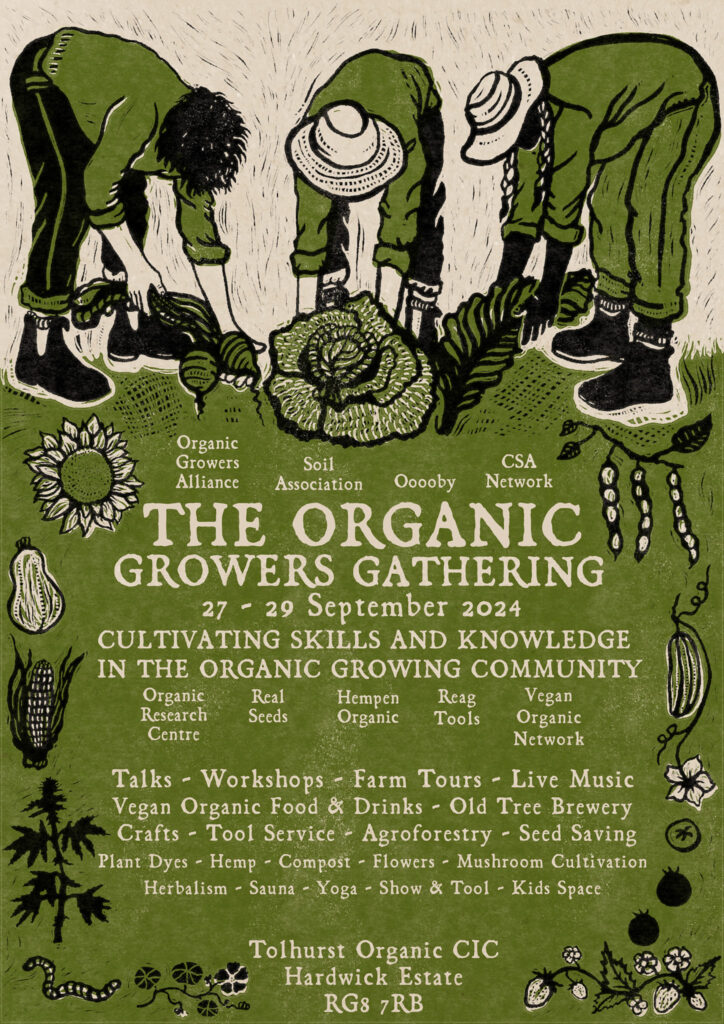
 So she emailed Tolly and Tamara at Tolhurst Organic and arrived in autumn 2022, just in time to harvest squash. The introduction was “a lot of fun” and then there was a ‘farm hack’ get together of like-minded growers which has now become the Organic Growers Gathering hosted by the VON and OGA.
Says Alice: “Living and working at Tolhurst Organic and Hardwick Estate made me realise that to do this type of work you really need a rural community around you for moral support. Without the interest and involvement of your community it’s really hard to sell your product.”
Working in food manufacturing showed her how much faith people place in products being clean, uniform and pre-packaged. Organic vegetables are covered in mud, making it hard to breach the marketing gap with what consumers expect from supermarkets: “Showing shoppers and children how their vegetables look when they are growing in the field can really change that, suddenly things look much healthier covered in mud.”
Leaving Tolhurst Organic, Alice knew she wanted to farm and had the skills to establish a farm business. Responding to an advert, everything “fell into place” when she met another Alice, Alice Favre, who is the custodian of the Chettle Estate. Alice Favre aims to create an example of a working community with access to wild spaces and agroecological food grown on the farmland around the village. There are 33 houses in the “benevolent feudal” village, with below market rents and a shared ethos extending to partaking in regular community events and shared meals and using the village shop instead of driving to a supermarket. Alice Favre has supported the veg growing business “by providing very reasonable rent for the land and barn, lots of resources like hours of help from the village builders, grant funded fencing and co-investing in the polytunnel structures. It just goes to show that farming tenancies can be far more creative than they have traditionally been in favour of supporting an agroecological farmer to make a success of starting.”
At the moment Alice grows whatever she wants for Chettle Village Stores which is “very data driven. It is really handy as the data shows exactly how much broccoli is currently being sold and so gives an indication of how much I’ll need to grow in future. I am focusing on having several varieties of each vegetable to create longer harvest windows and keep people inspired in the kitchen.”

In her first year. Alice will grow brassicas, leeks, onions, carrots, squash, purple sprouting broccoli and polytunnel crops such as aubergines, tomatoes, herbs and salads. She also cultivates cut flowers “because the bright colours look great alongside the veg”. An ambition is to grow loofahs, which would suit the circular ethos of the village.
Her advice to people who want to get into stock free organic growing depends where you are. On finding a market: “A lot of market gardens set up a box scheme, I don’t want to; it’s a lot of work and you need a certain amount of employees and facilities to make it all run smoothly. Growing for a shop, I can harvest three or four crops a day into the back of my truck and I can manage that alone. When I’m able to fund a team member I will look to supply local shops, cafes and restaurants. I think I’ll have a niche in fulfilling small orders”
On her own ethos: “I learned to grow vegetables using organic methods. I spent some time working on a conventional fruit farm in Kent which made me realise how many chemicals can be involved in growing our fresh food. The chlorine used to wash the fruit burned my eyes, and I knew that I didn’t want that in my body.” From Tolhurst, she learnt stock free organics, which she describes as “one step further”. The appeal for Alice is that the food she’s growing is not contaminated with any medications or hormones or anything that’s come from the animal industry, saying that “the food has a much shorter supply chain and I can be more sure of ethical good practice”.
“I choose to grow stock-free because it makes my farm more resilient for the future as I am not dependent on continuing success of local animal farms for adding fertility. It saves a lot of money to use woodchip and it smells a lot better- if there is an alternative to growing my vegetables in old poo then I am keen to take it! Green manures are beautiful and provide such a diverse habitat within a less intensively farmed system. Children from the village love to see the different leaves and flowers and the vibrant greens bring me a lot of joy through the winter. Farming with nature feels natural and optimistic in an ever-changing world as I am reminded to always notice the little things.”
At Chettle, there’s lots of woodchip readily available. But one barrier is the investment required in green manure seeds. Alice spent almost £2,000 on initial green manure seed for her seven acres and gets no crop profit from that. It also took a long time to sow the seed by hand and much of it didn’t germinate as the Mustard grew too tall and shaded the lower growing plants. “Using animal manure is probably cheaper and faster and I can understand why it’s the norm. It will continue to be the norm unless small organic farmers are able to make better environmental decisions through the provision of some support funding’.
Alice is currently in conversion to be accredited Soil Association organic certification from April 2025 and stockfree organic at the same time: “I’m very proud of it and I’d like to shout about it. I’ll certainly market my products as stock-free and teach customers about the alternatives to growing food without animal inputs.”
 Above all, Alice’s message is about the importance of new entrant farmers and growers to go and learn on a stockfree organic farm to try out the method. The big appeal for her is “how beautiful and varied it is. There are no worries about chemical contamination and there is always something green and growing for other organisms to live on or eat from. I just do it because I love it and am constantly inspired by how much variety of life there is.”